There are moments in a room that arrive so lightly they barely register unless you are already paying attention. A curtain moves an inch before the light changes. The fabric lifts, then settles. A window that looked static a second ago begins to suggest air. The room has not become dramatic. Nothing has announced itself. And yet the atmosphere has shifted. These are the kinds of domestic moments I keep returning to because they ask for a slower, more faithful kind of seeing. They remind me that visual stories do not always begin with strong events. Often they begin with soft evidence that the room is alive.
One reason I love photographing curtains is that they sit at the threshold between inside and outside without ever becoming fully one thing or the other. They are part architecture, part fabric, part weather instrument. They translate invisible air into visible movement. They hold light, soften edges, and create mood without asking for attention in the loud way larger objects often do. Even when they are still, they carry the possibility of motion. Even when they are plain, they can become emotionally rich once light begins to move across them.
That is what makes them such compelling subjects for a visual essay. They allow the image to feel inhabited without requiring a person in frame. They suggest time, breath, passing weather, privacy, and interior life all at once. A curtain is never only cloth. In the right moment, it becomes a record of what the room is receiving from the world beyond the window.
Some of the most moving photographs begin where almost nothing happens, except that the room quietly changes its mind.
Why Curtains Matter in Domestic Photography
Most people do not think of curtains as emotionally central objects. They are treated as practical background: there to shade a room, soften a view, offer privacy, finish a window. But this practical role is exactly why they matter photographically. Unlike decorative objects that are placed in order to be looked at, curtains already belong to the lived rhythm of a room. They are touched by light several times a day. They move when the window opens, when the weather changes, when someone passes nearby, when heat gathers, when evening begins. They are part of the room’s breathing.
That built-in relationship to air and time gives them unusual depth as a subject. A curtain can make a photograph feel calm or expectant depending on how it hangs, how it catches light, or how much movement it carries. A heavy still curtain near dusk can make the room feel protected. A pale one lifting in the morning can make the same room feel newly opened. The object is simple. Its emotional behavior is not.
For me, that is always the beginning of a visual story worth making: when an ordinary object starts carrying emotional information without becoming theatrical. Curtains do not demand interpretation. They simply offer it.
The Moment Before the Light Changes
I think the most interesting window scenes often happen just before the light itself becomes obviously different. We usually notice light only after it has already turned golden, already gone blue, already begun to leave the room. But there is a quieter interval before that visible shift, when the room begins to prepare itself. The curtain lifts slightly. The edge of a fold brightens. A soft line of shadow appears on the floor where there was none moments earlier. The table near the window looks less solid and more receptive. This pre-change atmosphere is one of the most delicate things a camera can catch.
What makes it so beautiful is its restraint. You are not photographing dramatic sunlight through dust or an obvious cinematic storm. You are photographing anticipation. The image works because it holds a room in transition before the transition becomes legible to everyone. That quality is deeply aligned with the kind of visual storytelling I care about. I am less interested in spectacle than in the earliest signs that a room is beginning to feel different.
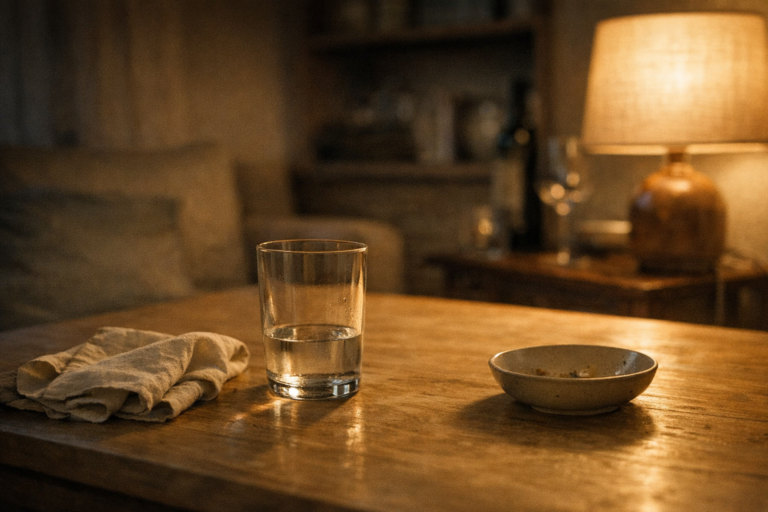
To photograph that well, you need patience more than equipment. You need to watch the curtain long enough to understand how it is moving. Is the motion cyclical or irregular? Is the air slight or persistent? Is the room receiving cool light or warm light? Is the curtain carrying the scene alone, or is there another object nearby that can help the atmosphere become readable? A chair, a glass, a table edge, a wall with a soft shadow, a book left near the sill. These companion objects matter because they help the motion of the curtain enter a larger visual sentence.
How to Build a Strong Curtain-Based Visual Story
I rarely begin close. The first frame should usually establish the room’s relationship to the window. Where does the curtain sit within the space? Is it the main subject or part of a broader domestic arrangement? A wider composition tells you whether the scene’s emotional strength comes from isolation or context. Sometimes the curtain alone is enough. Other times the image becomes far more compelling once you include the pale chair beside it, the wooden table at the edge of the frame, or the line of shadow forming across the floorboards.
Once that relationship is clear, I look for rhythm rather than perfection. Curtains are persuasive when they remain slightly unpredictable. If every fold is corrected and every edge is smoothed, the image begins to feel styled in a way that weakens its intimacy. A curtain should still look like fabric affected by life, not a prop waiting for approval. One lifted edge, one crease that catches more light than expected, one area of softness where the cloth briefly loses structure: these are often the parts that make the frame feel true.
Light is doing at least half the narrative work here. It should not be over-edited. Curtains thrive in tonal subtlety. Pale fabric especially can flatten quickly if the exposure is too aggressive. I usually prefer to preserve softness, even if that means the room appears quieter and less obviously polished. A good curtain image should feel breathable, not optimized. The viewer should sense air before they notice technique.
- Begin with one wide frame that shows the curtain in relation to the room.
- Move closer only after the emotional role of the curtain is clear.
- Let one nearby object support the scene without competing with the fabric.
- Preserve slight asymmetry; it often creates the feeling of lived motion.
- Expose for softness so the cloth remains believable and the room retains air.
That sequence keeps the photograph from becoming generic. It turns the curtain from a decorative edge element into a subject that carries mood, timing, and structure.
What Curtains Can Say Without a Person Present
One reason curtains work so well in humanless interiors is that they retain the suggestion of presence. Someone opened the window. Someone chose this fabric. Someone lives in a room where light and air arrive in this way. But none of those people need to appear directly for the photograph to feel inhabited. This is important to me because I often want intimacy without exposure. I want the image to feel personal without requiring a body to deliver that feeling. Curtains allow exactly that. They make the room expressive on its own.
They can also carry different emotional registers depending on the hour. Morning curtains tend to feel receptive, new, almost hopeful. Afternoon curtains can feel suspended and slightly drowsy. Evening curtains become more protective, especially once interior light begins to warm them from behind. The same object can move through multiple emotional roles in a single day. That flexibility makes it ideal for visual storytelling. You are not locked into one kind of atmosphere. You are responding to the room’s own timing.
And yet, what interests me most is still that in-between state: not fully bright, not fully dim, not fully still, not fully moving. It feels closest to how many meaningful domestic moments actually occur. We do not always notice the beginning or end of change. We notice the subtle shift in the middle, when something ordinary begins to feel charged with attention.
Common Mistakes
The first mistake is chasing drama too hard. Curtains do not need to become grand in order to become beautiful. If you push the grade too far, add too much contrast, or wait only for the most exaggerated movement, the image often loses the quiet truth that made it worth photographing. The second mistake is isolating the curtain so completely that it no longer belongs to a room. Unless abstraction is your goal, curtains usually work best when they remain in conversation with surfaces nearby. The third mistake is tidying the scene into sterility. A room should still feel used, not staged into silence.
I also think photographers sometimes underestimate how much time this subject requires. A curtain may do very little for several minutes and then suddenly become expressive for three seconds. If you arrive with a rushed mindset, you will miss that shift. This kind of work rewards waiting. It rewards standing still long enough for the room to reveal how it changes before the light obviously does.
Closing Thought
When the curtain moves before the light changes, the room offers a warning so soft it feels like a gift. Something is arriving. The air has already entered. The surfaces are already beginning to respond. The photograph, if it is made with patience, can preserve that exact threshold: the second before everyone else would have called it a scene.
That is why I keep returning to curtains, windows, and the smallest motions of indoor life. They remind me that visual stories are not built only from visible events. They are also built from the first tremors of change, when a room becomes briefly more alive than usual and asks, very quietly, to be noticed.
With thanks to mrva.com for designing the DewFrame WordPress theme.

When you submit a comment, this site may store your name, email address, comment text, submission time, and sender IP address for moderation, anti-spam, and security records.